Which crampon fits a walking boot depends on the binding and on how stiff the boot is. The one to start with is the Salewa Alpinist Walk.
Salewa says its soft front and rear bindings fasten all shoe types, especially those without sole edges.
The other two are the Black Diamond Contact Strap and the Grivel Monte Rosa New Classic.
All three come with anti-balling plates.
If you buy through an Amazon link here, the site earns a small commission and your price does not change.
The three crampons, by binding and points:
- For the most points of the three, choose the Salewa Alpinist Walk: 12 steel points on a front and rear basket binding.
- For a strap binding on 10 stainless steel points, choose the Black Diamond Contact Strap, with anti-balling plates included.
- For a 10-point crampon sold to fit most styles of boots, choose the Grivel Monte Rosa New Classic, with removable anti-balling plates.
| Your day out | What to carry |
|---|---|
| You want 12 points on a basket binding | Salewa Alpinist Walk |
| You want a strap binding on 10 stainless steel points | Black Diamond Contact Strap |
| You want a 10-point crampon sold to fit most styles of boots, with removable anti-balling plates | Grivel Monte Rosa New Classic |
Salewa Alpinist Walk
You want 12 points and a basket binding that Salewa says fastens all shoe types
Salewa Alpinist Walk Crampon 12 steel points, anti-balling plate includedFront and rear basket binding for all shoe types Read the full specification on AmazonThe Alpinist Walk weighs 855 g, with a plastic weave binding at the back and the front. Twelve points is two more than the other two.
Salewa’s manual says the Walk system can be used with all solid boots.
Black Diamond Contact Strap
You want a strap binding on a 10-point stainless steel crampon
Black Diamond Contact Strap Crampons Classic 10-point stainless steel cramponStrap binding, anti-balling plates included Read the full specification on AmazonBlack Diamond describes the Contact as a classic 10-point crampon for mountaineering and glacier travel.
This one fastens with a strap at the toe. Black Diamond’s European page gives the weight as 808 g, and its US page gives 872 g.
Grivel Monte Rosa New Classic
You want a 10-point crampon sold to fit most styles of boots, with removable anti-balling plates
Grivel Monte Rosa New Classic Crampons 10 points in totalAnti-balling plates included and removable Read the full specification on AmazonThe Amazon listing says the Monte Rosa New Classic is rated EN 893. Grivel calls the plates Antibott.
It is sold to fit most styles of boots. The listing does not name the binding type, so check it against your boot grade before you order.
What the winter advice means by crampons
The Park says you cannot reach the Yr Wyddfa summit in winter conditions without specialised equipment.
The Eryri National Park Authority gives “crampons or ice axes and knowing how to use them” as the examples.
Adventure Smart Wales says the section above Clogwyn Station on the Llanberis Path becomes banked out with snow and hard ice. Ice axes, crampons and the knowledge and skills to use them are, in its words, “absolutely essential here in winter”.
For the mountains of Wales, the British Mountaineering Council (BMC) says to take crampons and an axe. The trigger is a forecast or condition report that suggests freezing temperatures and extensive areas covered in snow and ice.
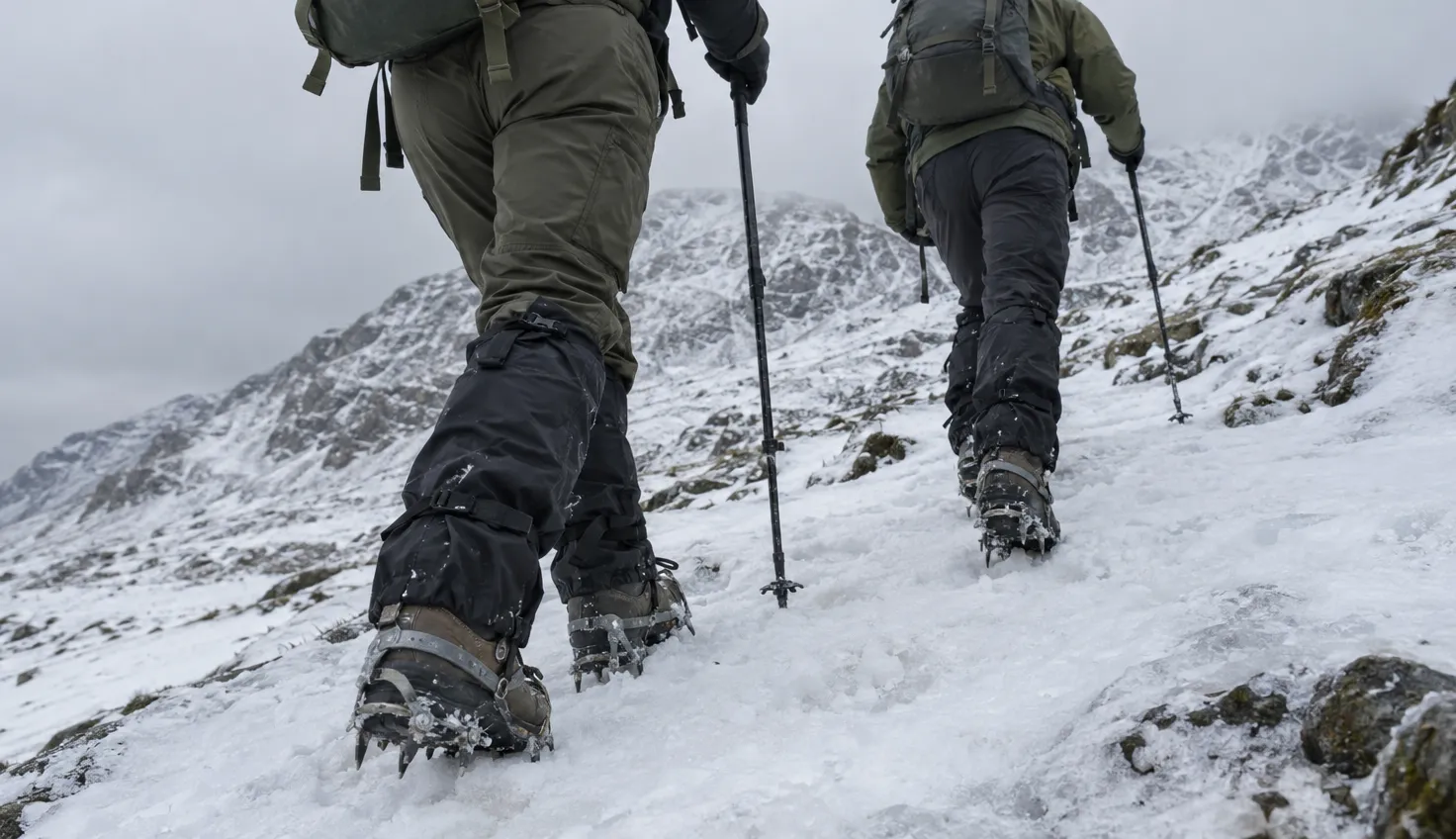
A walking crampon is a frame of metal points fixed to the boot by a binding.
How to choose a crampon for a walking boot
Choose the boot grade first, because a boot that bends can make the crampon fall off.
The BMC says a boot must be crampon-compatible, with at least a semi-stiffened midsole. It grades boots from B0 to B3:
- B0 is unsuitable for crampons. Most summer walking boots flex for comfort and are not rigid enough in the midsole.
- B1 suits the easiest snow and ice of hill walking. An example is a short patch in the shoulder seasons at lower elevations, not a full day’s walk.
- B2 is a stiff flex boot for four-season mountaineering. It can be used with crampons all day and will likely take a heel clip.
- B3 is a rigid technical boot with a welt (a ledge on the sole) for a heel clip.
A B1 boot could only be recommended with a C1 crampon. The BMC describes C1 as a flexible walking crampon attached with straps and toe and heel baskets.
A B3 boot takes C3, C2 and C1. The heel-clip kind of C2 needs a boot that takes a heel clip.
Then look at the crampon itself:
- Points: C1 crampons normally have 10 or 12 points. A 12-point crampon adds two forward points for steeper ground.
- Steel: the BMC says all-purpose hill-walking crampons should be steel. Aluminium crampons are specialist and not designed for use in the UK or mixed conditions. The Salewa is steel and the Black Diamond stainless steel.
- Anti-balling plates: the BMC says all crampons should have them. Plastic or rubber plates stop snow balling up under your foot, which would give real potential for a slip.
- Wear: plates wear or detach, and replacements can be bought.
Fitting them before the day
The BMC says the importance of getting crampons fitted in a shop cannot be overstated.
If you already own stiff 3 or 4 season boots, take them to the shop and get a suitable pair of crampons fitted.
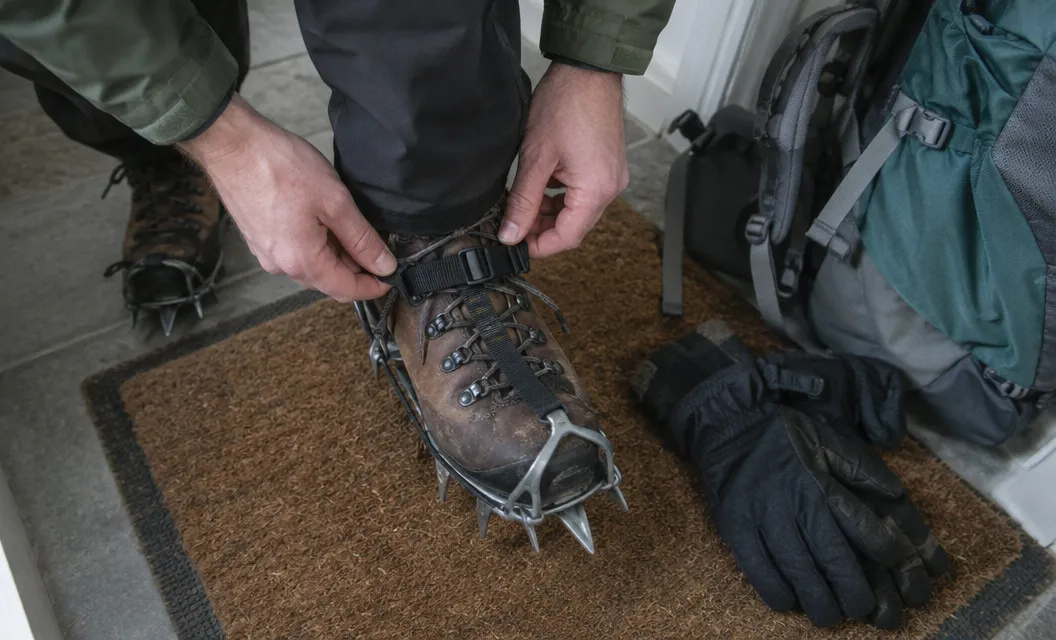
The bar that joins the front and heel pieces sets the size. It fits all but the largest boots, when an extra-long bar may have to be bought separately.
Straps can be cut shorter after fitting to make them less of a trip hazard, but not too short.
Before the season, check that the crampons fit the boots you intend to use. Check the strap, the plates and the bar for wear.
Put crampons on before the ground steepens. Elfyn Jones, a former BMC access officer for Wales, says walkers tend to put them on too late and then try to fit them on a steep icy slope. The BMC advises stopping to find a flat spot.
Check the crampons are still tightly fitted a few minutes after setting off.
Learning to walk in crampons
The BMC says the best way to learn is from someone more experienced, or on a course run by a qualified instructor.
Practise in a safe, controlled place first. Adventure Smart Wales points walkers who think conditions are beyond their ability to a winter skills course or a guided walk.
Reading the conditions before you go
In winter the Park publishes Ground Conditions Reports for Yr Wyddfa, and says they should be an integral part of your preparations.
You can find them on the Ground Conditions Reports page. For the conditions on the mountain itself, read about Snowdon in winter.
For the winter summit the Authority names crampons and ice axes. It does not mention microspikes. Carry an ice axe with your crampons.
The right walking boots decide which crampon fits.
We compile and explain public route and safety information. We guide nobody and sell nothing on the hill.
Which crampon for which boot
Only a B0 boot rules out crampons altogether.
| Boot | Crampon |
|---|---|
| B0, a flexible summer boot | None |
| B1, a semi-stiffened midsole | A C1 crampon, fitted in a shop |
| B2, a stiff four-season boot | Fitted together in a shop |
| B3, a rigid technical boot | Strap or basket fixings, fitted in a shop |
- A B0 boot: no crampon here, because the BMC calls it unsuitable for crampons.
- A B1 boot: the BMC recommends only a C1 crampon. The Salewa Alpinist Walk and the Black Diamond Contact Strap use the strap-and-basket fixings it describes for C1; have them fitted to your boots in a shop.
- A B2 boot: have the boots and crampons fitted together in a shop first.
- A B3 boot: the BMC says it takes C3, C2 and C1. The same two use the fixings it describes for C1; have them fitted in a shop.
The Grivel is sold to fit most styles of boots, so check its binding against your boot grade before you order.
For a walking boot with a stiff enough sole, start with the Salewa Alpinist Walk, and have it fitted to your boots before the day.