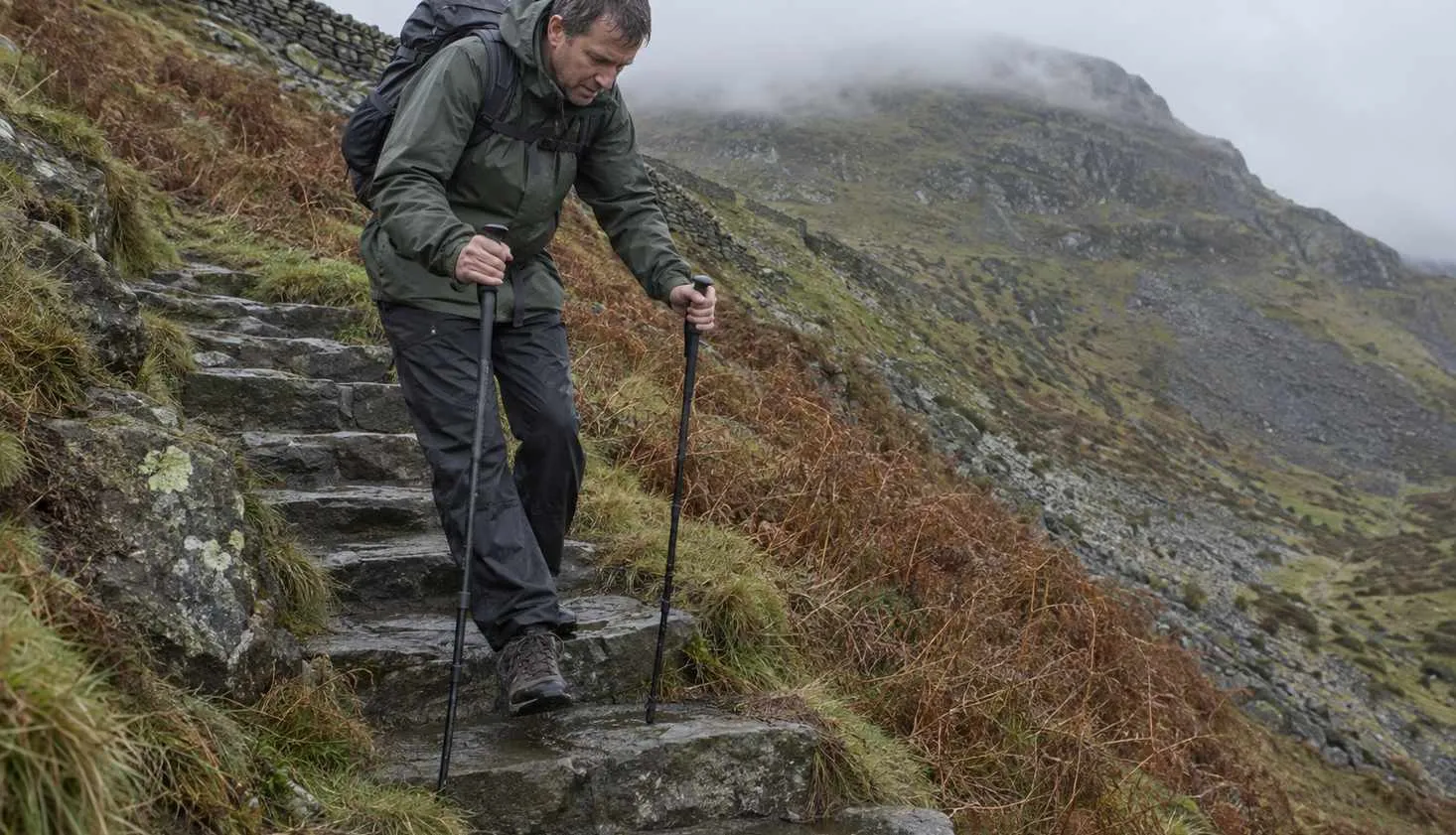
Your knees do not hurt on the way up Snowdon. They hurt on the way down.
For that job the LEKI Makalu Lite AS is the pair to buy. It is the only one of the three here with a shock absorber built into the shaft.
We compile and explain public route and safety information. We guide nobody and sell nothing on the hill.
The links to Amazon on this page are affiliate links. Buy through one and the site takes a small commission, and what you pay stays the same.
The three at a glance
Only the LEKI has suspension, and only the Black Diamond publishes a 140 cm top end.
Slide it sideways for the rest →
| Makalu Lite AS | BD Trail | Trespass Stryder | |
|---|---|---|---|
| Locking system | Speed Lock + lever | Dual FlickLock | Qiklock |
| Adjustment range, cm | 100 to 135 | 100 to 140 | Not published |
| Packed length, cm | 67 | 64.6 | Not published |
LEKI Makalu Lite AS, Black Diamond Trail and Trespass Stryder, on their makers' own figures.
| Your day out | What to carry |
|---|---|
| Your knees already complain on the long descents | LEKI Makalu Lite AS |
| You are tall, or want a lever lock you can work in gloves | Black Diamond Trail |
| You want a first pole to find out whether poles suit you | Trespass Stryder |
LEKI Makalu Lite AS
Your knees already complain on the long descents
LEKI Makalu Lite AS trekking poles 253 g, packs to 67 cm, adjusts 100 to 135 cmSpeed Lock plus lever, DSS shock absorber, 12 mm tip Read the full specification on AmazonBest for anyone whose knees already complain on the long descents.
LEKI publishes this for the standard size:
- Adjusts from 100 to 135 cm
- Packs to 67 cm
- Speed Lock plus lever locking, on aluminium shafts
- A Dynamic Suspension System in the tip, with a trekking basket
The shock absorber is the reason this pair heads the list. LEKI says it reduces impact force by around 40 per cent, and attributes that figure to a study at the University of Tübingen.
LEKI gives a single weight of 253 g and does not say whether that is one pole or the pair. Black Diamond’s 480 g is for the pair.
LEKI also writes that the grip head is fully rubberised for control when descending. That matters because the way down is where you grip the top of the pole rather than the handle.
Where it is the wrong choice: if the poles will spend most of the year in a cupboard. It is the most specified of the three, and a specification does nothing in a cupboard.
Black Diamond Trail
You are a tall walker, or want a lever lock you can work in gloves
Black Diamond Trail trekking poles, pair 480 g the pair, 64.6 cm collapsed, adjusts 100 to 140 cmDual FlickLock levers, snow baskets included Read the full specification on AmazonBest for a tall walker, and for anyone who wants a lever lock they can work in gloves.
Black Diamond publishes this:
- A collapsed length of 64.6 cm
- A usable length of 100 to 140 cm, in three adjustable sections
- Dual FlickLocks, an EVA foam grip and a strap
- Recycled aluminium shafts, snow baskets included, and a two year warranty
The 140 cm top end is the highest published here, and length is what a tall walker runs out of first. The LEKI stops at 135 cm.
There is no shock absorber in this model. Black Diamond’s own range lists separate Shock models, and the Trail is not one of them.
Where it is the wrong choice: if the knees are the whole reason you are buying. That is what the LEKI’s suspension is for.
Trespass Stryder
You want a first pole to find out whether poles suit you
Trespass Stryder lightweight walking pole Aluminium shaft, Qiklock adjustment, double EVA foam gripCarbide tip with rubber stopper Read the full specification on AmazonBest as a first pole for someone who wants to find out whether poles suit them.
Trespass lists a lightweight aluminium shaft, Qiklock height adjustment, a double EVA foam grip with a padded strap, and a carbide tip with a rubber stopper.
Check the quantity before ordering. Trespass names the item “Lightweight Trekking Poles Stryder” and its features panel calls it a twinpack. The product title, the reviews and the Amazon listing all say “each”.
Read it as one pole until the basket says otherwise.
Where it is the wrong choice: as the pair you take up Snowdon every month. Its weight and length range are not published, which does not matter on a valley path and does on a long descent.
Why they help most going down
The British Mountaineering Council puts the mechanism plainly. Stepping down, it writes, squeezes the cartilage of the knee joint “dry of its lubricating fluid”.
That is why the soreness arrives after a day of long descents rather than during the climb. Poles move part of that load into your arms.
The Council’s descending technique is three things, and it is worth learning before the first steep step:
- Put your hands on top of the pole handles rather than around them
- Lean forward, and plant both poles on the step below you
- Take some weight through them, and step down lightly
There is one safety point that is not optional, and it cuts the other way.
On boulder fields, scrambles and stream crossings, take your hands out of the straps. The Council’s reason is that a pole must be droppable in a slip.
Straps that hold your hands to a pole can stop you reaching for the rock you need. That is the one place where poles make the ground more dangerous rather than less.
The Council also states plainly that Nordic walking poles are not suitable for hill use. A UK search for walking poles returns a great many of them.
Check the length before you buy
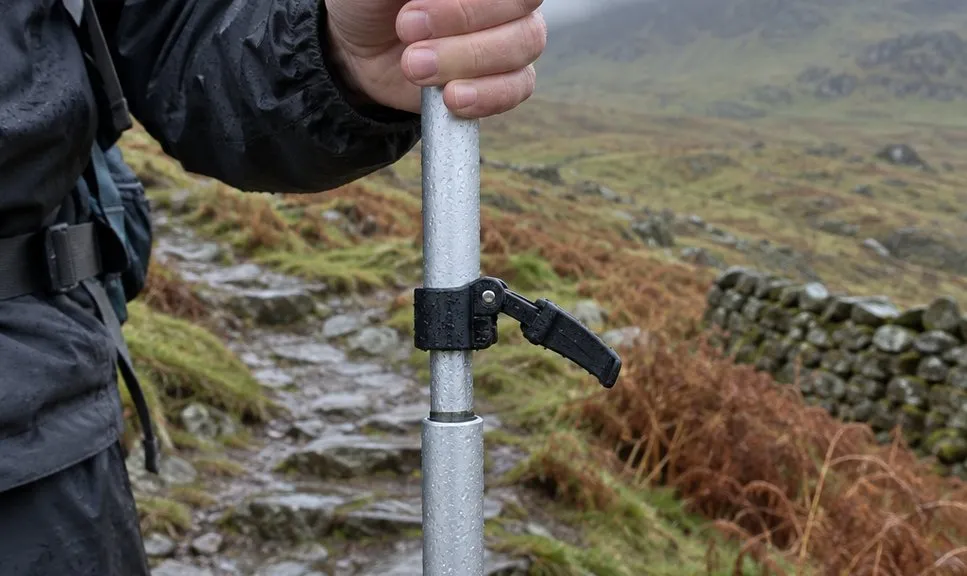
If the top of the adjustment range cannot set the pole with your elbow at a right angle, the poles are wrong whatever they weigh.
Set a pole so your elbow sits at a right angle with the tip on the ground.
A pole that packs to 64.6 cm goes inside a day sack. One at 67 cm is close enough that you should measure your own sack first.
When you do not need a pair at all
If your walking is lakeside paths and the lower valleys, poles are a preference rather than a fix.
The British Mountaineering Council says the same in one line. “If you’re only taking a short walk with a light pack, leave the poles behind or save them for the steep descents.”
Poles used constantly also take practice away from your own balance, which is the Council’s other caution about carrying them everywhere.
If you already own one pole and use it happily, a second one is an upgrade rather than a necessity.
Buy the pair when the descents start hurting, or when you start carrying a heavier sack.
Which of the three to buy
If the descents are what hurt, buy the LEKI. It is the only pair here with suspension in the tip.
If you are tall, or you want a lock you can work in gloves without thinking, buy the Black Diamond.
If you have never used poles and want to find out, buy the Trespass, and order it expecting one pole.
A pole only helps on the descent you actually use it on. That means getting it out at the top, not at the bottom.
The descent is also the part of the day people underestimate, and that is worked through in how long it takes to climb Snowdon.
It is the same stretch that turns up again and again in why walkers need rescuing in Snowdonia.