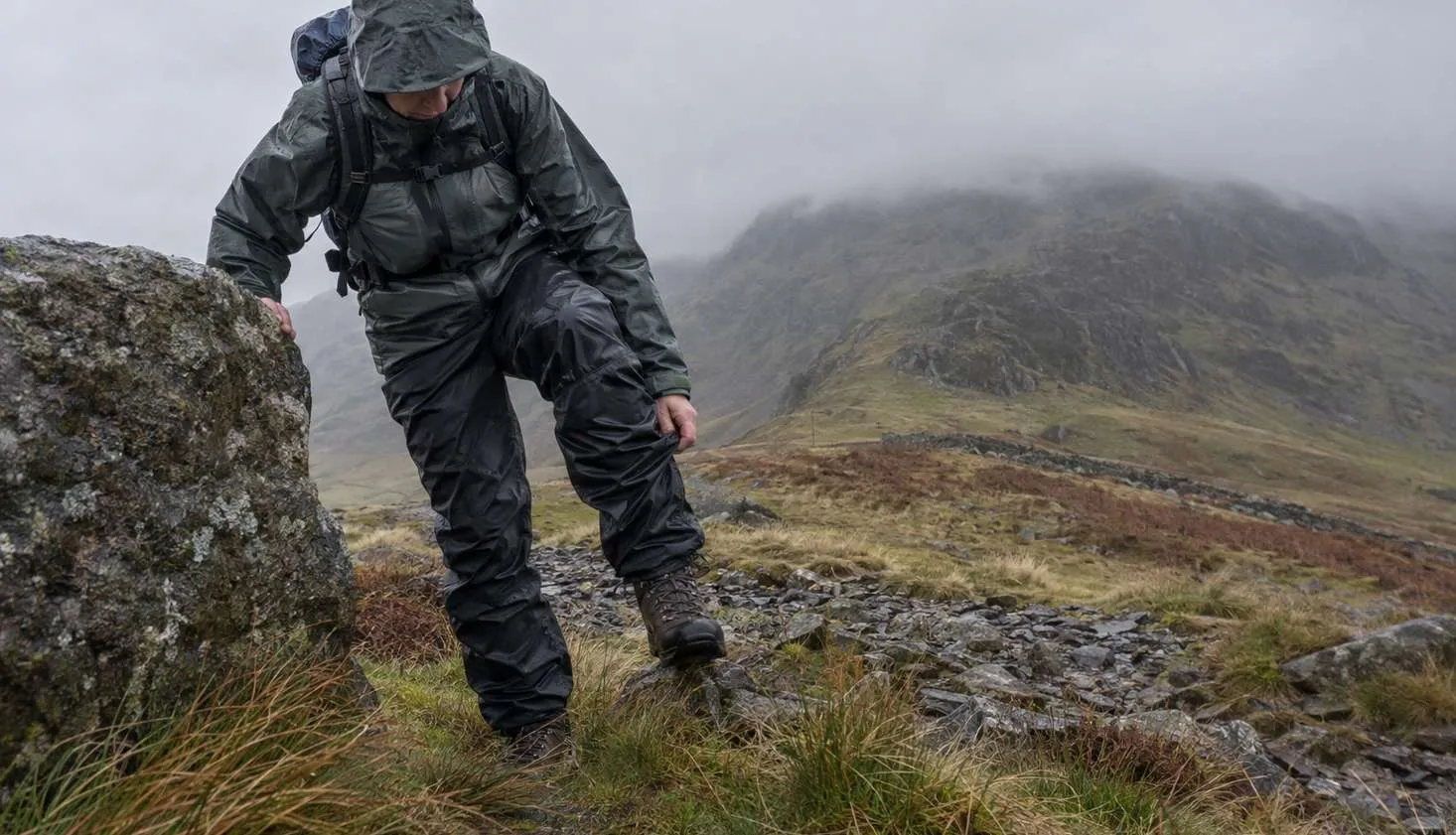
A pair of overtrousers only helps if you actually put them on.
Most of them stay in the rucksack.
On an open hillside in wind, that is not laziness. Getting into most pairs means balancing on one leg, and on many of them it means unlacing a boot first.
So the thing that decides this purchase is the side zip, not the waterproof rating.
For a wet day in Eryri the Montane Cetus is the pair to buy.
The links to Amazon on this page are affiliate links. Buy through one and the site takes a small commission, and what you pay stays the same.
The three at a glance
Two of the three have side zips. The Regatta lists none.
Slide it sideways for the rest →
| Montane Cetus | Deluge 2.0 | Regatta Pack-It | |
|---|---|---|---|
| Side zips | Yes, length unstated | Three-quarter, snaps | None listed |
| Waterproof rating, mm | 20,000 | 12,000 | Not published |
| Breathability | RET under 7 | 18,000 g/m²/24h | 10,000 g/m²/24h |
| Weight, g | 320 | 374 | Not published |
Montane Cetus, Berghaus Deluge 2.0 and Regatta Pack-It, on their makers' own figures. Montane gives breathability as RET (lower is better), the others in g/m²/24h, so that row does not compare directly.
| Your day out | What to carry |
|---|---|
| Walking Welsh hills through autumn and winter | Montane Cetus Waterproof Pants |
| A handful of Welsh hill days a year, zips still there when needed | Berghaus Deluge 2.0 Pant |
| The emergency pair that lives in the rucksack, March to October | Regatta Pack-It Overtrousers |
Montane Cetus Waterproof Pants
Walking Welsh hills through autumn and winter
Montane Cetus Waterproof Pants 20,000mm hydrostatic head, RET rating under 7320 g, AquaGuard side zips, hems adjust over boots Read the full specification on AmazonBest for anyone walking Welsh hills through the autumn and winter.
Montane publishes this for them:
- A 20,000mm hydrostatic head, the highest published here (Regatta gives none)
- A stated weight of 320 g
- AquaGuard side zips. The UK page gives no length, and Montane’s US site lists them as three-quarter length, long enough to clear a boot
- An elasticated hem that adjusts over boots
- BARRIER treatment at the openings and hems, which Montane says stops water wicking in
Where it is the wrong choice: if the pair will live in the car for occasional light rain. It is the most specified of the three, and that specification does nothing in a car boot.
Berghaus Deluge 2.0 Pant
A handful of Welsh hill days a year, zips still there when needed
 Berghaus Deluge 2.0 waterproof overtrousers 12,000mm hydrostatic head, 18,000 G/M2/24hrsThree-quarter length side zips with snap fasteners Read the full specification on Amazon
 Best for a handful of Welsh hill days a year, with the zips still there when you need them.
Berghaus publishes this:
- A hydrostatic head of 12,000mm
- A weight of 0.374 kg
- Three-quarter length side zips and snap closures
- An elasticated waist with side adjustment, and articulated legs
Berghaus describes the zips as ideal for ventilation and for what it calls no-fuss changing.
Where it is the wrong choice: if you are out in weather most weekends. The Montane publishes a higher rating and a lower weight.
Regatta Pack-It Overtrousers
The emergency pair that lives in the rucksack, March to October
 Regatta Pack-It waterproof overtrousers ISOLITE 15000 fabric, taped seamsPacks away into its own stuff sack Read the full specification on Amazon
 Best as the emergency pair that lives in the rucksack from March to October.
Regatta publishes this much:
- ISOLITE 15000 fabric
- Taped seams
- An elasticated waist, unlined, with two side pocket openings
- Packs away into its own stuff sack
Regatta gives no hydrostatic head figure for these, and no weight.
With no side zip listed, you sit down and take your boots off, whatever the ground is like.
That is a real cost on a mountain and a small one on a valley path.
This pair works best as the spare you carry and hope not to need.
Where it is the wrong choice: as the only pair you own for the tops. Taped seams are good, an unstated rating and no zip are not.
What the side zip is actually for
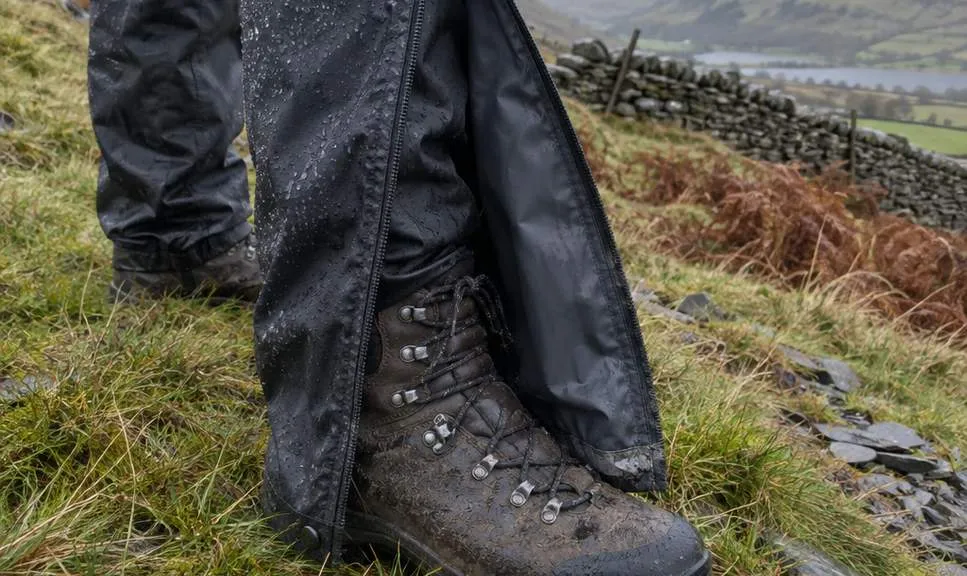
A zip long enough to clear a boot is the difference between putting the trousers on and deciding not to bother.
The British Mountaineering Council gives the rule in one line. “It’s easier to be able to pull them on and off while your boots are on, so make sure there are zips down the sides.”
Rain on Snowdon rarely starts in the car park.
It starts twenty minutes up, in wind, on a slope with nowhere dry to sit. A three-quarter zip turns that into a thirty second job, standing up.
A pair with no zip means kneeling in the wet to unlace a boot first. That is why walkers finish the day wet, with dry overtrousers still in the bag.
What the numbers mean on a wet day
The gap between 12,000mm and 20,000mm matters far less than whether the trousers are on your legs.
Hydrostatic head is a laboratory measure. It records how much water pressure a fabric holds off before it lets water through.
Zip length and weight will change your day more often than the fourth digit of a rating will.
When you do not need to buy a pair
If your walking is valley paths and the lower lakes, and you turn back when it looks grim, the trousers in your wardrobe will do.
Wet legs on a low path are uncomfortable. Wet legs on an exposed ridge in wind are how people get cold fast.
If you are new to the hills, the question is usually a simple one. Is this one more thing you have to buy before a first big walk?
Overtrousers are not, for a summer walk up the Llanberis Path in a settled forecast. They become one the moment you go higher, later in the year, or with children who cannot warm themselves up by walking faster.
The British Mountaineering Council writes that “a waterproof outer layer of jacket and trousers will help to keep you dry”. It names both halves, and the trousers are the half most walkers leave at home.
The pair for your kind of walking
If you are out in Welsh weather most months, buy the Montane. The highest published rating here, the lowest published weight, and zips that clear a boot.
If you walk the hills a few times a year, buy the Berghaus. Three-quarter zips and a 12,000mm rating cover everything Snowdonia will do to you on a walking day.
If you want a spare to carry all summer and rarely open, buy the Regatta. It packs into its own sack and asks the least of the room in your rucksack.
Keep it for that job and not for the tops.
Whichever you buy, the zip is what you are paying for, because it is what makes you put them on while you are still dry.
We compile and explain public route and safety information. We guide nobody and sell nothing on the hill.
The jacket half of this decision has its own answer in what actually keeps you dry on a Welsh hill. The rest of the list sits in what to pack for a day in Snowdonia.