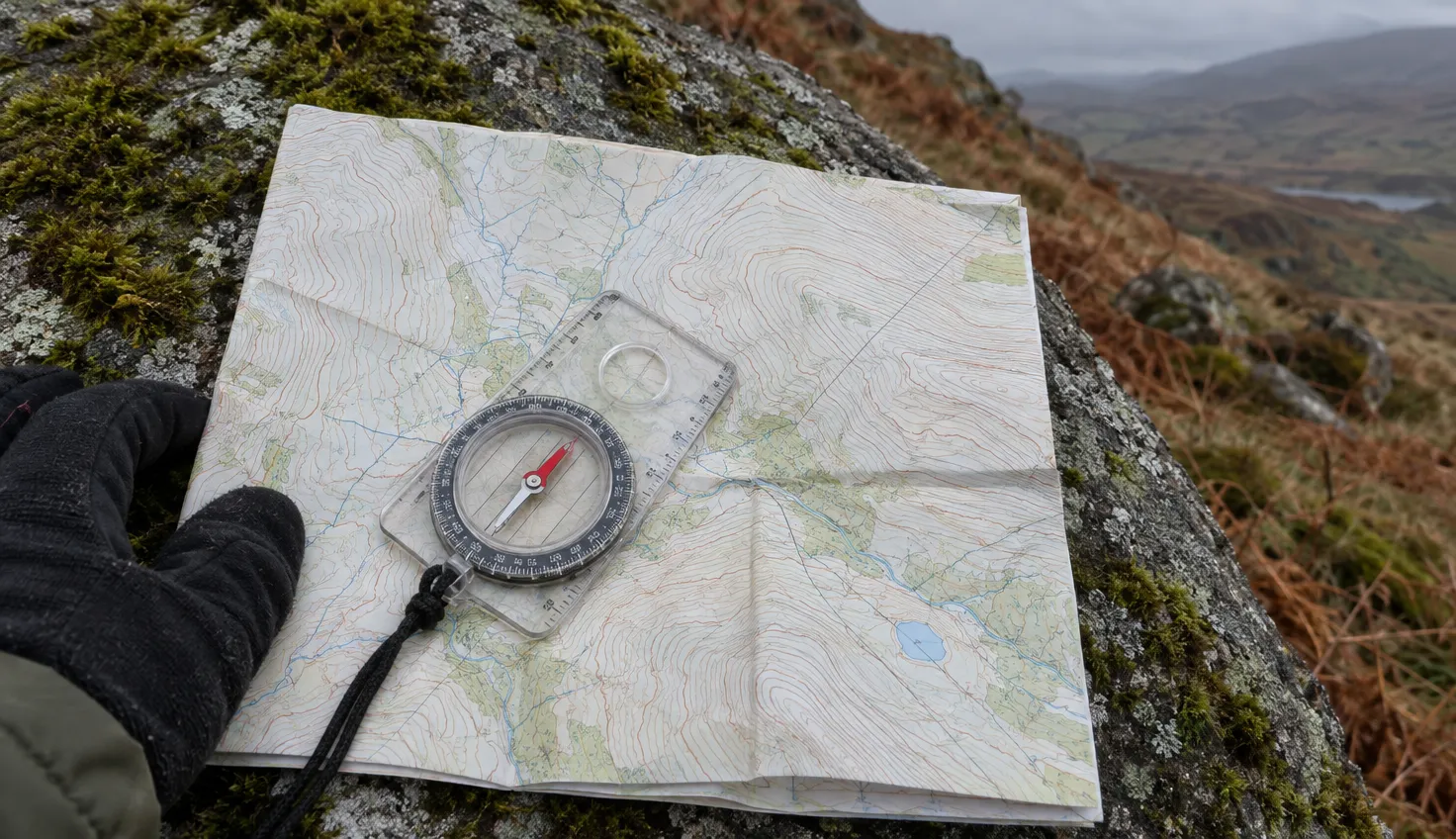
A toy compass has no rotating bezel and no romer (a small printed scale that matches the map’s scale). Ordnance Survey (OS), Britain’s national mapping agency, says such a basic compass will never be very accurate.
For a first real compass, start with the Silva Ranger.
It carries romers for 1:25,000 and 1:50,000 maps on a clear baseplate, and its housing rotates.
Links to Amazon on this page pay the site a small commission if you buy, at no extra cost to you.
| Your day out | What to carry |
|---|---|
| You have no compass, or only a toy one, and want a baseplate compass with 1:25,000 and 1:50,000 romers | Silva Ranger |
| You want a baseplate compass with a third romer scale and adjustable declination | Silva Expedition 4 |
| You want to sight a bearing across open ground through a mirror | Silva Ranger S |
| You want a mirror compass with a global needle and a stated weight | Suunto MC-2 G |
Silva Ranger
You have no compass, or only a toy one, and want a baseplate compass with 1:25,000 and 1:50,000 romers
Silva Ranger baseplate compass Romers for 1:25,000 and 1:50,000 mapsRotating housing, magnifier, 1° accuracy Read the full specification on AmazonSilva calls the Ranger a traditional baseplate compass used by hikers, mountaineers, backpackers and hunters. It has a rotatable housing, a magnifying lens and a baseplate marked in millimetres.
The Ranger is the plain choice: Silva lists an accuracy of 1° and rates it user level Basic.
Silva Expedition 4
You want a baseplate compass with a third romer scale and adjustable declination
Silva Expedition 4 baseplate compass Romers 1:25k, 1:40k and 1:50kDeclination adjustment, luminous markings Read the full specification on AmazonSilva describes the Expedition 4 as a full-size baseplate compass made for experienced navigators and used by rescue workers. It has romers for 1:25,000, 1:40,000 and 1:50,000, a liquid-filled capsule and a magnifying lens.
Of the three Silva compasses here, only the Expedition 4 lists declination adjustment. The Ranger and Ranger S list a declination scale only.
On an OS map, declination (OS also calls it magnetic variation) is the angle between magnetic north and grid north.
Silva Ranger S
You want to sight a bearing across open ground through a mirror
Silva Ranger S mirror sighting compass Mirror sighting with 45-degree angle assist1:25,000 and 1:50,000 scales Read the full specification on AmazonSilva calls the Ranger S an easy-to-use mirror sighting compass for finding direction over long distances. The mirror shows the dial and the landscape at the same time, and a sighting hole helps with accurate bearings.
It adds a 45-degree angle assist to the mirror sighting.
The baseplate carries 1:25,000 and 1:50,000 scales, the housing rotates, and Silva lists an accuracy of 1°.
Suunto MC-2 G
You want a mirror compass with a global needle and a stated weight
Suunto MC-2 G mirror compass Global needle for all magnetic zonesAbout 75 g, clinometer, 5x magnifier Read the full specification on AmazonSuunto, the Finnish sports-instrument maker, says its global needle works at all of the earth’s magnetic field locations. The mirror has a notch and a hole for sighting and a 5x magnifying lens.
The MC-2 G weighs about 75 g, and it includes a clinometer (a scale for the angle of a slope).
Its romers cover 1:25,000 and 1:50,000, and Suunto calls the 1:25,000 one partial. The declination adjusts with a tool on the lanyard.
What a hill walking compass needs for OS maps
Look for four features: a clear baseplate, romers for your map, a rotating housing and a liquid-filled needle.
- A clear baseplate, so you can see the map features under the compass.
- Romers for the scale of your map. Match them to your OS map, at 1:25,000 or 1:50,000.
- A rotating housing, without which a compass will never be very accurate.
- A needle that floats in liquid, which lets it rotate freely without being too sensitive to movement.
OS also says that very cheap basic compasses can be poor. It lists driving, road cycling and emergency spare use as what a basic compass is for.
Baseplate or mirror
OS rates the baseplate best for accurate navigation with a map, and the mirror compass best for long treks in pathless terrain.
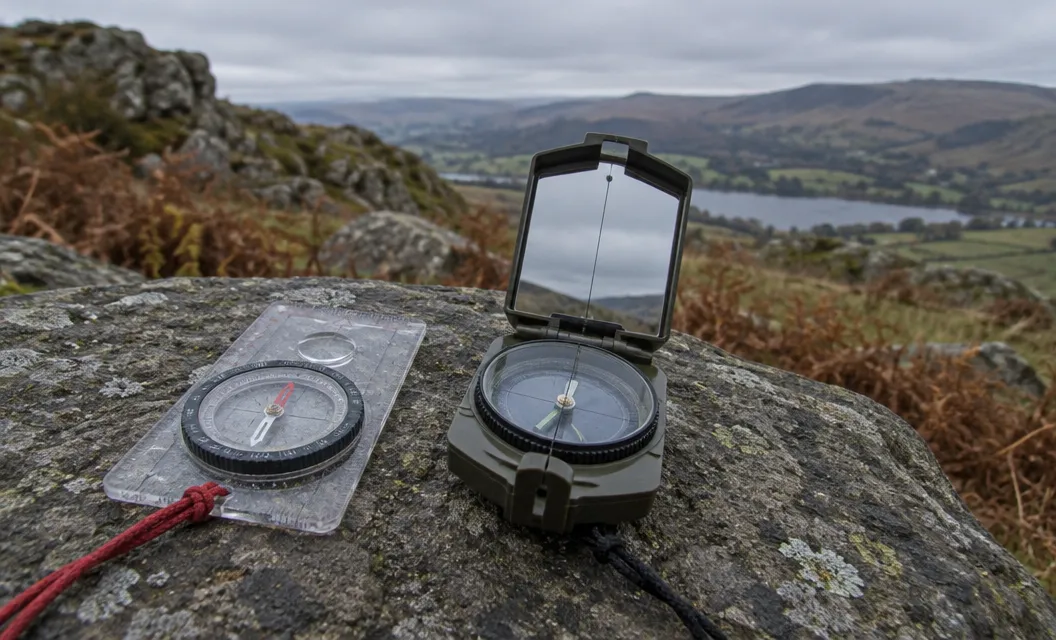
The baseplate is probably the most flexible type: it takes bearings, sets a heading and measures distance.
The mirror lets you see the dial and the landscape at the same time. Silva says a mirror compass is at its best in open terrain where you must find direction over long distances.
Where a compass matters on Yr Wyddfa
Walkers descending in fog or mist frequently get lost at the junction of the Pyg and Miners’ tracks.
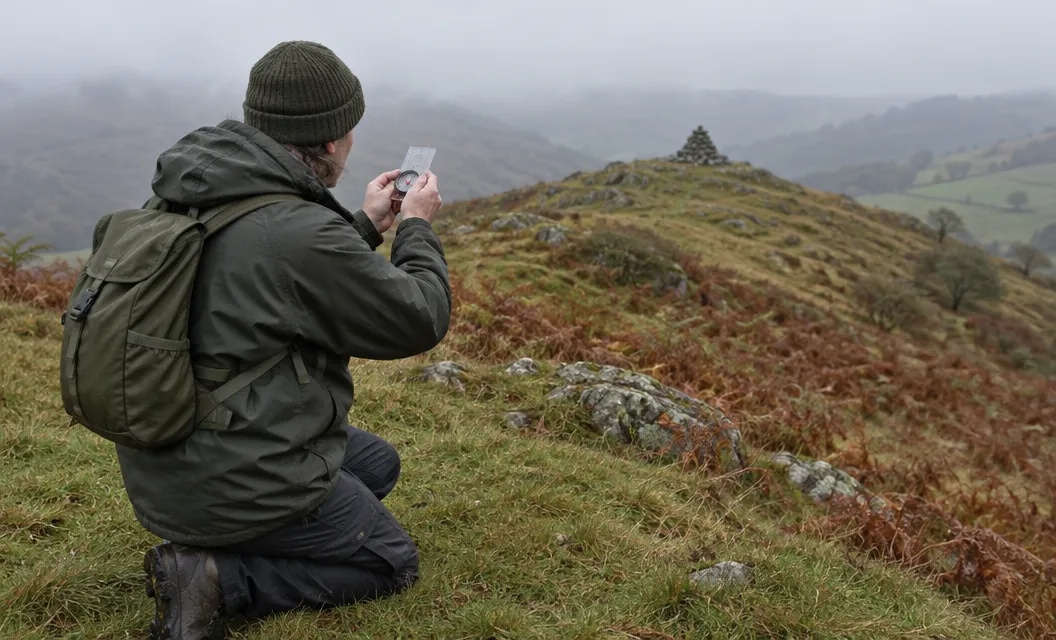
AdventureSmart, the UK outdoor-safety campaign, says this about Yr Wyddfa (Snowdon). It adds that a map and compass, and knowing how to use them, could literally be a lifesaver there.
Some walkers add a GPS as a backup. Before relying on any of this kit, read about staying safe in Snowdonia.
We compile and explain public route and safety information. We guide nobody and sell nothing on the hill.
After you buy: learn it, then practise
Plas y Brenin, which calls itself the National Outdoor Centre, runs a two-day Introduction to Navigation course at Capel Curig in Eryri.
It is for people new to hillwalking, has one instructor for six people, and covers taking bearings and using a compass.
The National Navigation Award Scheme (NNAS), a UK charity, runs navigation awards through approved course providers. Its Bronze award includes basic compass work.
Practise first on a short, low walk where the path is clear. When you can take a bearing without help, use the compass on a longer walk such as the Carneddau.