There is no walking route to the summit of Tryfan.
Yr Wyddfa has six walking paths to its cairn. Every one can be walked with your hands in your pockets.
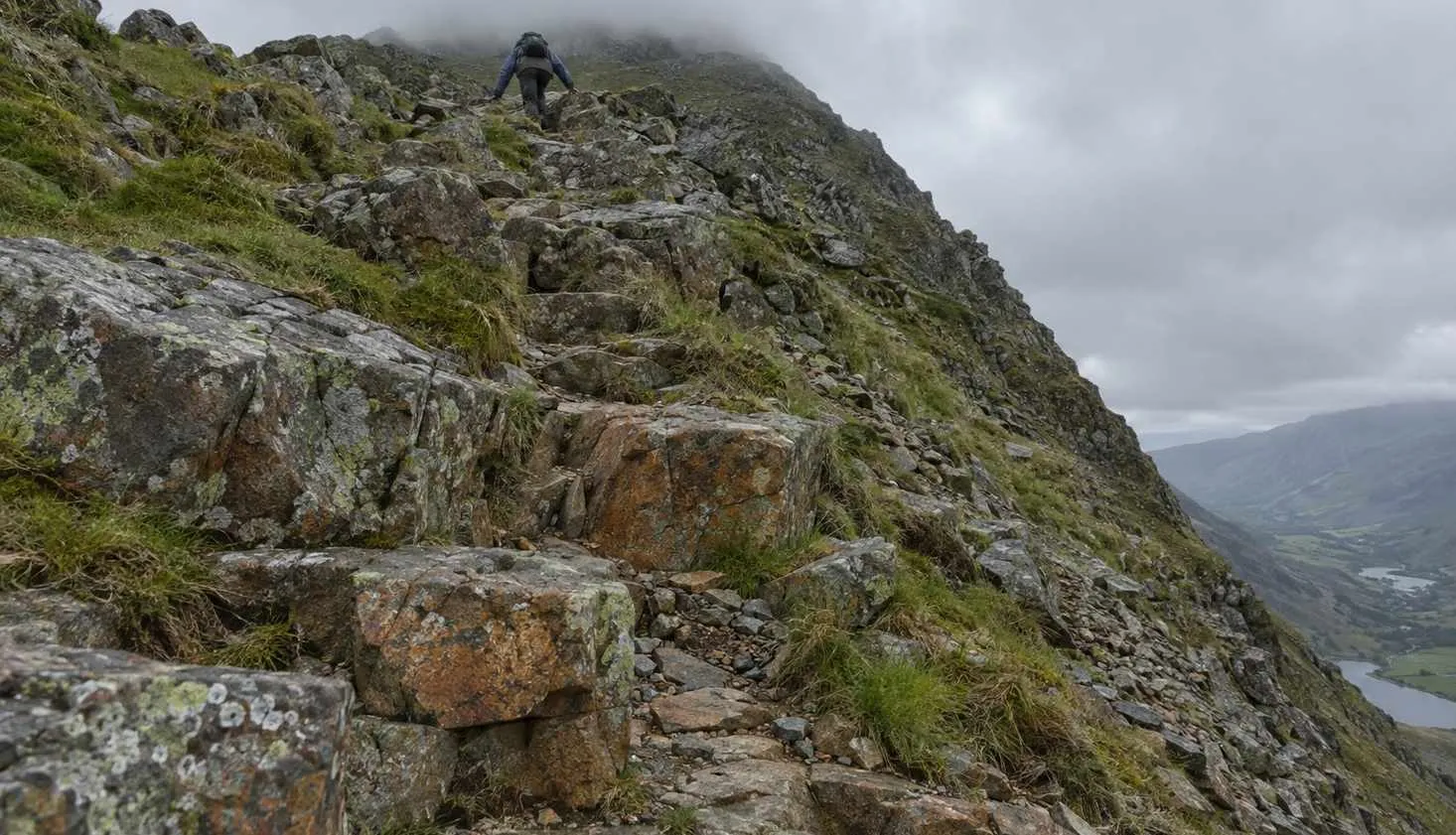
Tryfan has none. The National Trust, the conservation charity that looks after this ground, puts it plainly: “whichever route you choose to go up, you have to use your hands to reach the top”.
That is scrambling. It is the ground between walking and climbing, where your hands do real work.
The normal way up is the North Ridge. Here’s what that actually asks of you, and when to leave it for another day.
What a Grade 1 scramble actually means
British scrambles run from Grade 1 to Grade 3. Grade 1 is the lowest.
It means steep ground where you use your hands for holds and for balance. The moves stay straightforward, and a rope is not normally part of the plan.
Grades 2 and 3 add harder moves and bigger consequences. Those belong to climbers.
The British Mountaineering Council grades Tryfan’s North Ridge at Grade 1, and describes it as suiting “newbie scramblers looking for a gentle introduction”.
So the grade is honest. This is the entry level of scrambling, not the entry level of walking.
Two true things about this mountain
The BMC calls the North Ridge a gentle introduction. The National Trust says Tryfan is “only recommended for experienced and well-equipped hillwalkers”, and puts “not for beginners” on the page.
Both are right. They are answering different questions.
The BMC is grading the moves. The National Trust is describing the mountain.
Easy moves on serious ground: that combination is real, and Tryfan is the clearest example of it in Eryri. The scrambling itself is within reach of a fit hill walker on a dry day.
The exposure, the route-finding and the cost of a slip are not beginner level at all.
The BMC is grading the moves. The National Trust is describing the mountain.
Grade 1 tells you the moves are easy. It does not tell you the mountain is forgiving.
The North Ridge, the normal way up
Ordnance Survey publishes a route guide to the North Ridge, and the numbers look modest:
- Start: the Ogwen valley, with parking along the A5 on the shore of Llyn Ogwen
- Distance: 5.81 km
- Height gain: 535 m (1,755 feet)
- Time: three to four hours
- Map: OS Explorer OL17, the same sheet as Yr Wyddfa
The National Trust lists the summit at 917.51 m, one of the 14 Welsh peaks over 3,000 feet. On Tryfan the ground matters far more than the height.
Five and a half kilometres sounds like a short morning. It is not, because almost none of it is walking.
The ridge builds from steep, rough ground into continuous scrambling. The OS guide names two landmarks on the line: the Cannon Stone partway up, and Adam and Eve at the top.
Near the summit the BMC’s notes are worth reading closely. The final leg “allows you to choose between several easier or harder options, all of which converge on the twin stones of Adam and Eve”.
You can pick your difficulty on the upper ridge, and every line arrives at the same two stones.
Adam and Eve, the stones at the top
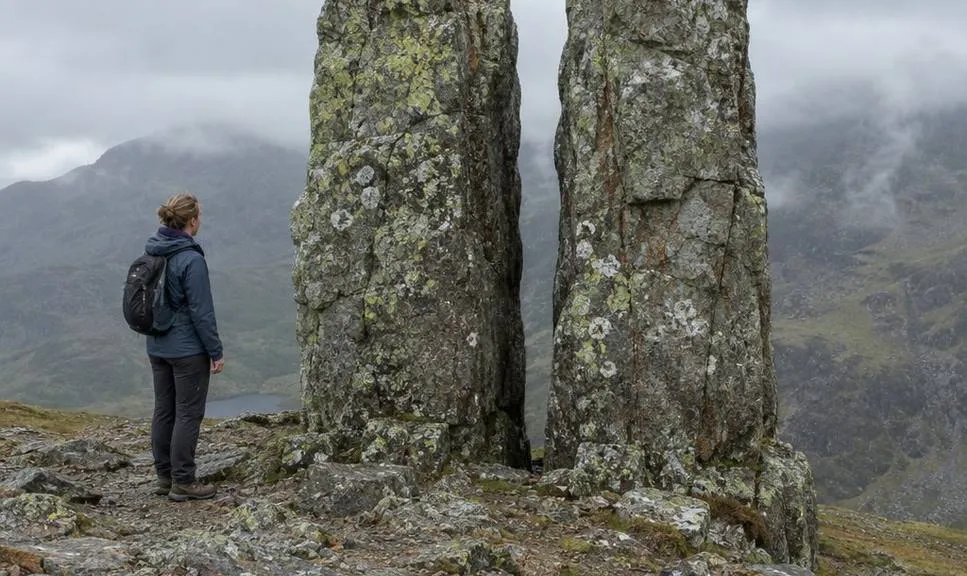
Two blocks stand on the summit, roughly three metres high, with a gap of about a metre between them.
Stepping across is a long-standing tradition called the Freedom of Tryfan. You do not have to do it.
Plenty of careful walkers reach the top, look at the gap, and decide the day is already complete. The stones sit at the very summit, with steep ground falling away on every side.
A fall from either block would be serious.
Reaching the stones is the achievement. Stepping between them is optional.
Coming down the South Ridge
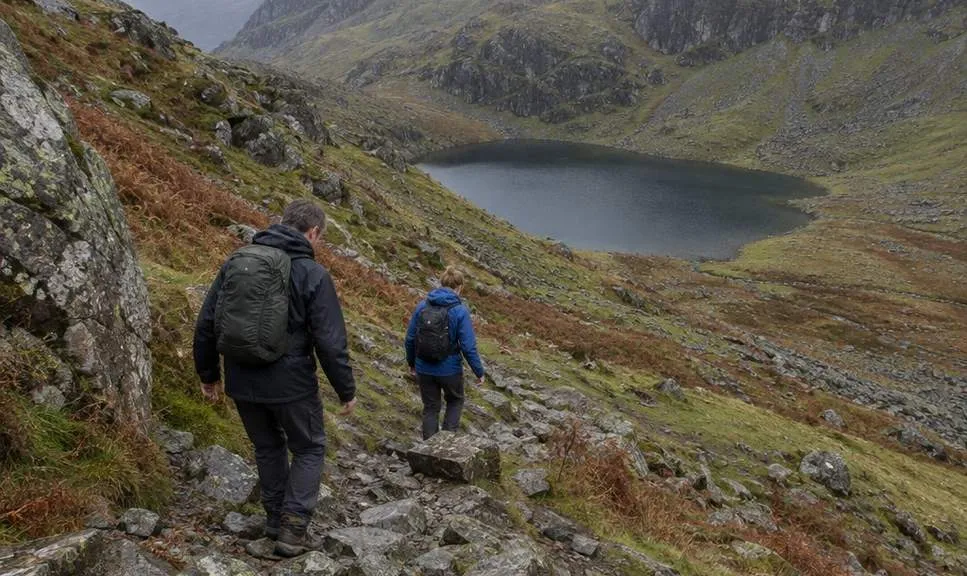
The BMC’s suggested descent leaves by the South Ridge:
- Down the South Ridge to Bwlch yr Tryfan
- The rocky path down towards Llyn Bochlwyd
- Across to Bochlwyd Buttress
- Back to the main road
Give this proper time. The BMC warns that route-finding on Tryfan is difficult in bad weather, and that people get lost in cloud or stuck in gullies.
Tired legs make rough ground rougher. Treat the descent as part of the route, not the end of it.
Wet rock and low cloud
Most of your safety is settled before you leave the road.
Dry rock, light wind and a clear forecast make the North Ridge a friendly place to learn what scrambling feels like. The BMC is specific about the opposite: rain makes the rock slippery, and low cloud makes route-finding much harder.
Check the mountain forecast from the Met Office, the UK’s national weather service, the night before and again in the morning.
A valley forecast tells you very little about this ridge.
An Ordnance Survey route review warns that the ridge faces north. It sits in shade on an early start and can hold ice as late as April.
In full winter conditions the route needs an ice axe and crampons, and it stops being a scramble at all. That is a different day out needing different skills.
Wet rock and low cloud are the two conditions that should change your plan.
Deciding before you start
The three checks published by Adventure Smart Wales fit Tryfan closely:
- “Be honest with yourself about you and your companions’ knowledge, fitness and ability”
- “Check the latest weather and ground conditions”
- “Take advice and only attempt an activity if the conditions are within you and your companions’ capabilities”
Set your limits at the car. Decisions made high on a ridge are worse decisions.
Signs it is time to turn round:
- Rock already wet when you leave the road
- Cloud sitting on the upper ridge
- Wind strong enough to push you off balance
- Anyone in the group unhappy about the exposure
- A late start that would put the descent in the dark
Set your turn-back point at the car park, not on the ridge. Turning back on Tryfan is not a wasted day, and the mountain will still be there.
If a day does go wrong, how mountain rescue works in Snowdonia is worth reading before you need it.
What to take
Kit for Tryfan is a normal hill day plus one addition. Everything on the packing list for a day in Snowdonia applies, and then a helmet.
The North Ridge is popular, and loose stone comes down from groups above. A helmet is the one thing to add.
If you do not own one, you can compare walking helmets on Amazon, or try one on in a shop first.
The Amazon link above is an affiliate link. Should you buy through it, a small commission comes back to the site, and your price stays as it was.
Wear your stiffest boots. Soft soles turn rough rock into hard work.
Is Tryfan your next step?
Most people arrive here after Yr Wyddfa, having already chosen between the six paths up Snowdon.
It gets compared with Crib Goch, the park’s other famous Grade 1. The two are not the same test.
Crib Goch is about exposure along a narrow ridge. Tryfan is about climbing on holds.
If the answer is yes, pick a dry day with a settled forecast, start early, carry OL17, and go with someone who has scrambled before.
We compile and explain public route and safety information. We guide nobody and sell nothing on the hill.
If the answer is not yet, that is a perfectly good answer. Spend a season on rougher walking ground first, then come back to the Ogwen Valley and look up at it again.